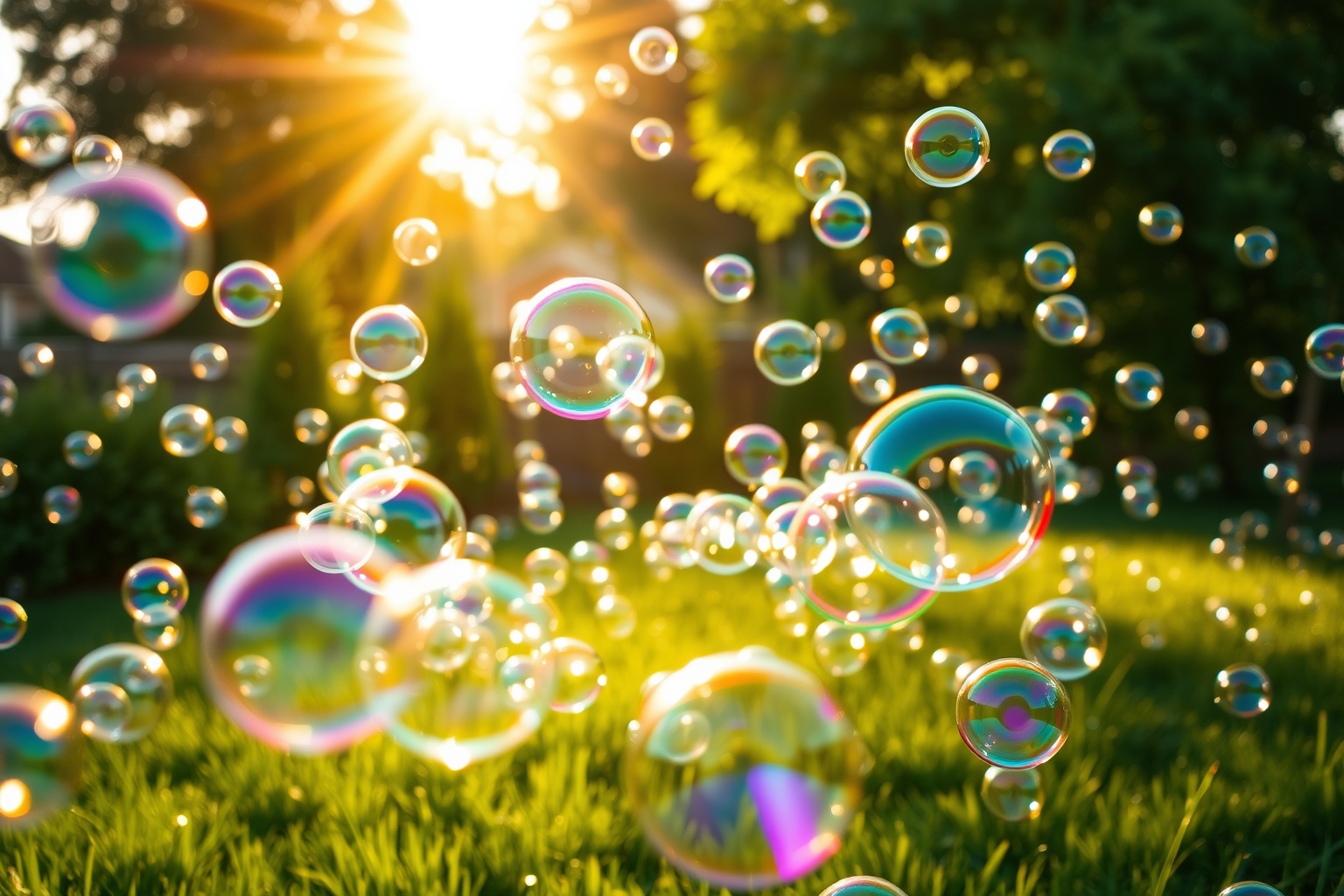
The atmosphere of a bubble party, in plain English
Walk into a well-run kids' bubble party and the air is full. Not a few bubbles drifting from a wand — thousands. They're catching late-afternoon sun, refracting little rainbows, and a roomful of children is chasing them with the kind of joy that's hard to fake. There's music. There's usually a "bubbleologist" — a real job title, oddly — running a 30 to 60 minute show with bubble tricks: square bubbles, smoke bubbles, bubbles inside bubbles, and the moment every kid waits for, when the birthday child stands inside a giant bubble taller than they are.
Or the version without a pro: two bubble machines on tables at either end of the garden, a tray of giant-bubble solution and a rope wand, a bluetooth speaker, and a group of three-year-olds losing their minds for an hour. Both count.
What actually happens, in order
A typical bubble party runs about 60–90 minutes. Roughly:
- Free-play bubbles (first 15 min) — machines on, kids arrive into a sky already full of bubbles, the energy is set.
- The show or organised activities (next 30 min) — either a performer running tricks, or you running games: bubble pop tag, biggest-bubble contest, freeze dance with bubbles.
- Snacks and cake (15 min) — machines off, kids sit down, sugar happens.
- Encore (10–15 min) — back outside, machines on, kids run wild one more time before favours go home.
What makes it a "bubble party" vs. a normal birthday party
Three things, mostly:
- Volume. A standard backyard party might have a single wand. A bubble party has automatic machines pumping thousands of bubbles per minute, plus interactive stations.
- Variety. Not just round bubbles — square ones, smoke-filled ones, bubble fountains, bubble caterpillars, and the giant walk-in bubble as the finale.
- One coherent theme. The decorations, activities, favours, and even the cake usually share the bubble theme. It feels like a world, not a list of activities.
Bubble party vs. foam party — they're not the same thing
People conflate them constantly. Two distinct experiences:
Many distinct bubbles
The point is the bubbles themselves — chasing them, popping them, making bigger ones, stepping inside one. Visual, interactive, sensory but contained. Works for almost every age.
One giant pile of foam
A foam cannon fills an area with thick non-toxic foam. Kids jump into it, build castles, have foam battles. Full-body, energetic, messier. Better for 4+ with eye protection.
You can absolutely combine them. Plenty of professional packages do — 30 minutes of bubble show, then 30 minutes of foam pit, then cake. But know which one you're getting.
Which ages a bubble party actually suits
Bubbles work for nearly every age — but what works changes dramatically.
Toddlers (1–3 years)
Best magic: an automatic machine producing a slow, steady stream they can chase and pop with one finger. Sensory bubble foam in a tray. Watching, not directing. Keep the volume low and the supervision close — they will absolutely try to drink the solution.
What doesn't work: foam parties (too much, too overwhelming), giant bubbles they can't pop themselves, structured games with rules.
Preschool (3–5 years)
This is the bubble-party sweet spot. Chase-and-pop games, freeze dance with bubbles, simple bubble art (food colouring + solution + paper). They can make their own bubbles with small wands and feel proud about it. Educators at Uniting note that group bubble-blowing teaches turn-taking and patience as a side effect.
Early elementary (5–8 years)
Add rules and challenges. Biggest-bubble contests. Bubble relay races. DIY bubble-solution experiments where they tweak the recipe and see what changes. They can handle giant rope wands with a bit of coaching, and they love the science of it — why are bubbles round, why do they pop.
Older kids (8–12 years)
Pure bubbles can lose them. This is where foam parties earn their keep. Otherwise: bubble obstacle courses, giant bubble dodgeball, advanced solution-making, glow-in-the-dark bubbles under blacklight for a dusk party. Skip "fire bubbles" — they're real, they look incredible on Instagram, and they should only be done by trained professionals.
The most common mistake is matching the volume of bubbles to the age. Toddlers get overwhelmed by foam-cannon blasts. Eight-year-olds get bored by a single bubble wand. Match the activity to the energy you want the kids to feel.
Indoor or outdoor?
Outdoor is easier nine times out of ten — bubble solution makes everything slippery, and grass is forgiving. Indoor parties are absolutely possible (and necessary in winter), but they need either professional non-slip mats or large tarps with absorbent covers, plus ventilation if you're doing foam.
Wind is the outdoor enemy. Bubbles pop fast in anything over a light breeze. Morning slots tend to be calmest. If wind kills the show, most performers can pivot indoors with smaller-scale tricks.
For the full venue checklist, jump to the planning guide.
The next thing to read
Depending on your path:
- Want to throw one yourself? → The DIY planner
- Want to book a pro? → Find a host
- Want to compare every type before deciding? → The five party types
- Worried about safety? → The honest safety guide